Every lake has a personality. Lake Conroe has two, and fishing them the same way is how visiting anglers waste a morning. Here is how to tell them apart.
Every lake has a personality, and Lake Conroe's is split down the middle. The southern half behaves like a suburb and the northern half behaves like a forest, and an angler who fishes both the same way will have a frustrating day on at least one of them.
This is a guide to reading those two halves and knowing which one to be on. It covers what swims here, where the structure sits, how the fishing shifts across the year, and the practical decisions that separate a productive morning from a long, hot boat ride. Whether you are launching your own rig or stepping onto a rental for the first time, the lake gives up fish to people who understand it and very little to people who guess.
The lake covers roughly 20,118 surface acres on the West Fork of the San Jacinto River, straddling Montgomery and Walker counties, and it has been filling since 1973. Five decades of submerged structure and a stable conservation pool around 201 feet above sea level have produced a fishery with real depth to it.
The main gamefish are straightforward:
Grass carp are also present under a triploid permit program. If you catch one it must be returned to the water immediately and unharmed, which is not a suggestion but a regulation.
This is the part that matters most, and it is the thing local anglers know that visitors usually do not.
The bottom two thirds of Lake Conroe is dominated by open water with a heavily developed shoreline. Bulkheads and boat docks line much of it, and that hard structure is the fishing. Docks provide shade, ambush points and baitfish, and a methodical angler working a line of them will out fish someone running the middle of the lake all morning. Four constructed fish habitat reefs have also been placed in the lake with published GPS coordinates, and they are worth putting into a chartplotter before you launch rather than hunting for on the day.
Move north and the character changes completely. Standing timber follows the old river channel, and the banks up here fall largely within the Sam Houston National Forest, which means mostly undeveloped and comparatively featureless shoreline. The timber is the target. It holds fish through more of the year than dock structure does, and it sees considerably less pressure because it takes longer to reach and is harder to fish without losing tackle.
Short version. Pressured conditions, bright sun and a busy weekend push you toward the docks in the lower lake. Overcast weather, low boat traffic and a willingness to lose a few lures push you north into the timber. Anglers who commit to one half and fish it properly do better than anglers who split the day trying both.
Seasonality on a Texas reservoir is more pronounced than visitors expect, and the same spot can be excellent in March and empty in July.
The best bass fishing of the year. Early spring pushes largemouth shallow around docks and cover as water temperatures climb, and they are aggressive, accessible and catchable from a bank as well as a boat. Crappie also stack up around structure in spring. If you can only fish Lake Conroe once, come now.
The hardest season, and the one that punishes bad timing most. Fish go deeper and feed in narrower windows, which means being on the water at first light and off it by midmorning. Deeper structure, the river channel edges and the habitat reefs become the productive water. Catfish stay cooperative throughout on cut shad or anything strong smelling, which makes them the sensible summer target for families.
The second peak, and arguably the most pleasant. Mid to late fall brings bass back toward docks and shallow cover as the water cools, boat traffic drops off sharply after the summer season, and the weather is comfortable enough to fish all day. Hybrid striped bass also become more active.
Quiet, cold by Texas standards rather than genuinely cold, and underrated. Fewer boats, deliberate fish, and the best chance at a large bass if you are willing to slow everything down. Crappie fishing around deep structure holds up well.
Technique advice is abundant and mostly useless without the logistics underneath it. These are the choices that actually determine whether you catch anything.
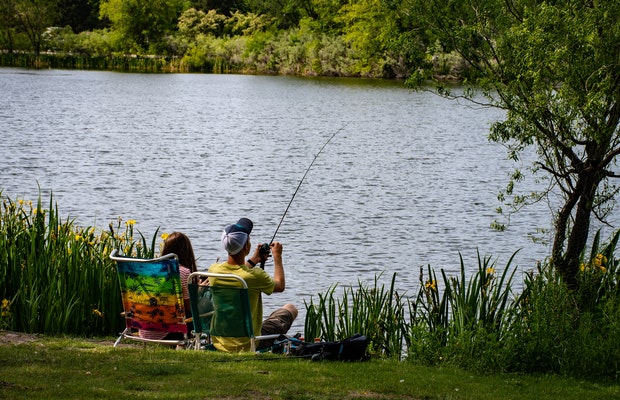
Plenty of visitors arrive without a trailer, and the assumption that this rules out fishing is wrong. Public access points around the lake offer bank fishing, and the developed southern shoreline with its docks and bulkheads is exactly the structure that holds fish, which means a well placed cast from land is genuinely competitive with a mediocre cast from a boat.
Rental options cover the middle ground. Pontoons work well for families who want a comfortable platform and are not chasing tournament results, and they are easy to fish from with children aboard. Kayaks and paddleboards get into the shallow coves and timber pockets that bigger boats avoid, and on a calm morning that is some of the most enjoyable fishing on the lake. Book rentals ahead for summer weekends, because walk up availability is unreliable.
Target catfish and bluegill rather than bass. They bite more often, they bite more predictably, and a child who catches six small fish has a better day than one who waits four hours for a big one. Keep the trip to two or three hours, go early, and bring far more snacks and water than seems reasonable.
The most common mistake visiting anglers make is booking accommodation far from the water and then losing the best hour of the day to a drive. Being on the lake at first light requires being near the lake the night before, and the difference in results is not marginal.
A base on the shoreline also solves the other half of the equation, which is what everyone who is not fishing does while you are out. A resort with a spa, an eighteen hole golf course and three acres of water park gives a family somewhere to be at seven in the morning that is not a boat ramp. Have a look at the lakeside suites if the trip involves other people, or the current resort offers if you are still choosing dates.
Lake Conroe is not a difficult fishery, but it is a specific one. It rewards anglers who know which half of the lake they are fishing and why, who match the season rather than fighting it, and who are on the water before the sun is high and the boat traffic has built. Everything else, the lure selection and the line weight and the endless debates about color, matters far less than those three decisions.
Start in spring or fall if you have the choice, work the docks in the lower lake or the standing timber up north depending on the light, and give yourself the first two hours of the day. Confirm the current regulations with Texas Parks and Wildlife before you launch, because the bass rules here are specific to this lake. The rest is a quiet morning on twenty thousand acres of Texas water, which is a reasonable thing to want on its own.